How To Format Usb Stick For Mac 2018
- Format Usb Stick Windows 10
- How To Format Usb Stick
- Format Mac Usb On Windows
- How To Format Usb Stick For Mac 2018
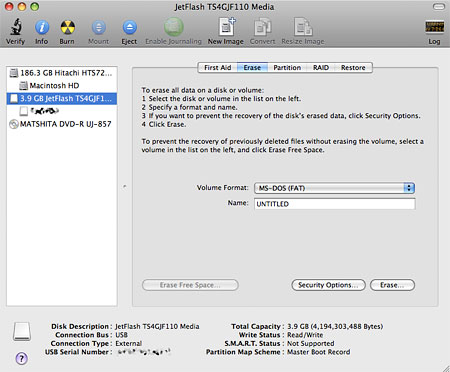
How to quickly make a Mac OS X bootable USB on Windows. Mauro Huculak @pureinfotech. April 11, 2018. After converting the USB flash drive from MBR to GPT format, you can use the steps below to create a bootable USB installation media to install Mac OS X. Windows 10 October 2018 Update (version 1809): All the new features and changes. Format ting a drive will erase all data and partiti on s on the disk:C on nect the hard drive or USB key to the Mac.Launch Disk Utility, located in Applicati on s > Utilities.Locate the drive name from the left hand side of Disk Utility and click on it.Click on the “Erase” tab across the to p.More items.
It can be tough transporting your videos and music to every device you use. How do you know your Mac, Xbox, and Windows PC can read your files? Read on to find your perfect USB drive solution.
- If you want to share your files with the most devices and none of the files are larger than 4 GB, choose FAT32.
- If you have files larger than 4 GB, but still want pretty good support across devices, choose exFAT.
- If you have files larger than 4 GB and mostly share with Windows PCs, choose NTFS.
- If you have files larger than 4 GB and mostly share with Macs, choose HFS+
File systems are the sort of thing that many computer users take for granted. The most common file systems are FAT32, exFAT, and NTFS on Windows, APFS and HFS+ on macOS, and EXT on Linux—though you may run into others on occasion. But it can be confusing understanding what devices and operating systems supports which file systems—especially when all you want to do is transfer some files or keep your collection readable by all the devices you use. So, let’s take a look at the major file systems and hopefully, you can figure out the best solution for formatting your USB drive.
Understanding File System Problems
Format Usb Stick Windows 10
Different file systems offer different ways of organizing data on a disk. Since only binary data is actually written to disks, the file systems provide a way to translate the physical recordings on a disk to the format read by an OS. Since these file systems are key to the operating system making sense of the data, an OS cannot read data off of a disk without support for the file system with which the disk is formatted. When you format a disk, the file system you choose essentially governs which devices can read or write to the disk.
Many businesses and households have multiple PCs of different types in their home—Windows, macOS, and Linux being the most common. And if you carry files to friends houses or when you travel, you never know what type of system you may want those files on. Because of this variety, you need to format portable disks so that they can move easily between the different operating systems you expect to use.
But to make that decision, you need to understand the two major factors that can affect your file system choice: portability and file size limits. We’re going to take a look at these two factors as they relate to the most common file systems:
- NTFS: The NT File System (NTFS) is the file system that modern Windows versions use by default.
- HFS+: The Hierarchical File System (HFS+) is the file system modern macOS versions use by default.
- APFS: The proprietary Apple file system developed as a replacement for HFS+, with a focus on flash drives, SSDs, and encryption. APFS was released with iOS 10.3 and macOS 10.13, and will become the mandatory file system for those operating systems.
- FAT32: The File Allocation Table 32 (FAT32) was the standard Windows file system before NTFS.
- exFAT: The extended File Allocation Table (exFAT) builds on FAT32 and offers a lightweight system without all the overhead of NTFS.
- EXT 2, 3, & 4: The extended file system (EXT) was the first file system created specifically for the Linux kernel.
Portability
You might think that modern operating systems would natively support each other’s file system, but they largely do not. For example, macOS can read—but not write to—disks formatted with NTFS. For the most part, Windows will not even recognize disks formatted with APFS or HFS+.
Many distros of Linux (like Ubuntu) are prepared to deal with this file system problem. Moving files from one file system to another is a routine process for Linux—many modern distros natively support NFTS and HFS+ or can get support with a quick download of free software packages.
In addition to this, your home consoles (Xbox 360, Playstation 4) only provide limited support for certain filesystems, and only provide read access to the USB drives. In order to better understand the best filesystem for your needs, take a look at this helpful chart.
| File System | Windows XP | Windows 7/8/10 | macOS (10.6.4 and earlier) | macOS (10.6.5 and later) | Ubuntu Linux | Playstation 4 | Xbox 360/One |
| NTFS | Yes | Yes | Read Only | Read Only | Yes | No | No/Yes |
| FAT32 | Yes | Yes | Yes | Yes | Yes | Yes | Yes/Yes |
| exFAT | Yes | Yes | No | Yes | Yes (with ExFAT packages) | Yes (with MBR, not GUID) | No/Yes |
| HFS+ | No | (read-only with Boot Camp) | Yes | Yes | Yes | No | Yes |
| APFS | No | No | No | Yes (macOS 10.13 or greater) | No | No | No |
| EXT 2, 3, 4 | No | Yes (with third-party software) | No | No | Yes | No | Yes |
How To Format Usb Stick
Keep in mind that this chart chose the native abilities of each OS to use these file systems. Windows and macOS both have downloads that can help them read unsupported formats, but we’re really focusing on native ability here.
The takeaway from this chart on portability is that FAT32 (having been around for so long) is supported on almost all devices. This makes it strong candidate for being the file system of choice for most USB drives, so long as you can live with FAT32’s file size limits—which we’ll go over next.
File and Volume Size Limits
FAT32 was developed many years ago, and was based on older FAT filesystems meant for DOS computers. The large disk sizes of today were only theoretical in those days, so it probably seemed ridiculous to the engineers that anyone would ever need a file larger than 4 GB. However, with today’s large file sizes of uncompressed and high-def video, many users are faced with that very challenge.
Today’s more modern file systems have upward limits that seem ridiculous by our modern standards, but one day may seem humdrum and ordinary. When stacked up against the competition, we see very quickly that FAT32 is showing its age in terms of file size limits.
| File System | Individual File Size Limit | Single Volume Size Limit |
| NTFS | Greater than commercially available drives | 16 EB |
| FAT32 | Less than 4 GB | Less than 8 TB |
| exFAT | Greater than commercially available drives | 64 ZB |
| HFS+ | Greater than commercially available drives | 8 EB |
| APFS | Greater than commercially available drives | 16 EB |
| EXT 2, 3 | 16 GB (up to 2 TB on some systems) | 32 TB |
| EXT 4 | 1 EB | 16 TB |
Every newer file system handily whips FAT32 in the file size department, allowing for sometimes ridiculously large files. And when you look at volume size limits, FAT32 still lets you format volumes up to 8 TB, which is more than enough for a USB drive. Other files systems allow volume sizes all the way up into the exobyte and zetabyte range.
Formatting a Drive
The process for formatting a drive is different depending on what system you’re using. Rather than detailing them all here, we’ll instead point you at a few handy guides on the subject:
The conclusion to draw from all this is that while FAT32 has its issues, it’s the best file system to use for most portable drives. FAT32 finds support on the most devices, allows volumes up to 8 TB, and file sizes up to 4 GB.
If you need to transport files greater than 4 GB, you’ll need to take a closer look at your needs. If you only use Windows devices, NTFS is a good choice. If you only use macOS devices, HFS+ will work for you. And if you only use Linux devices, EXT is fine. And if you need support for more devices and bigger files, exFAT may fit the bill. exFAT is not supported on quite as many different devices as FAT32 is, but it comes close.
READ NEXT- › How to Enable Google Chrome’s New Extensions Menu
- › How to Stop Spammers From Attacking Your Google Calendar
- › How to Power Off Your Samsung Galaxy Note 10 or 10 Plus
- › How to Switch from a Windows PC to a Mac
- › Want to Survive Ransomware? Here’s How to Protect Your PC
These advanced steps are primarily for system administrators and others who are familiar with the command line. You don't need a bootable installer to install macOS, but it can be useful when you want to install macOS on multiple computers without downloading the installer each time.
Download macOS
- Download a macOS installer, such as macOS Mojave or macOS High Sierra.
To download macOS Mojave or High Sierra for this purpose, download from a Mac that is using macOS Sierra 10.12.5 or later, or El Capitan 10.11.6. Enterprise administrators, please download from Apple, not a locally hosted software-update server. - When the macOS installer opens, quit it without continuing installation.
- Find the installer in your Applications folder as a single ”Install” file, such as Install macOS Mojave.
Use the 'createinstallmedia' command in Terminal
- After downloading the installer, connect the USB flash drive or other volume you're using for the bootable installer. Make sure that it has at least 12GB of available storage and is formatted as Mac OS Extended.
- Open Terminal, which is in the Utilities folder of your Applications folder.
- Type or paste one of the following commands in Terminal. These assume that the installer is still in your Applications folder, and MyVolume is the name of the USB flash drive or other volume you're using. If it has a different name, replace
MyVolumeaccordingly.
Mojave:*
High Sierra:*
Sierra:
El Capitan: - Press Return after typing the command.
- When prompted, type your administrator password and press Return again. Terminal doesn't show any characters as you type your password.
- When prompted, type
Yto confirm that you want to erase the volume, then press Return. Terminal shows the progress as the bootable installer is created. - When Terminal says that it's done, the volume will have the same name as the installer you downloaded, such as Install macOS Mojave. You can now quit Terminal and eject the volume.
* If your Mac is using macOS Sierra or earlier, include the --applicationpath Tax software for mac 2018. argument. The Sierra and El Capitan commands show the proper format of this argument.
Use the bootable installer
After creating the bootable installer, follow these steps to use it.
- Connect the bootable installer to a compatible Mac.
- Use Startup Manager or Startup Disk preferences to select the bootable installer as the startup disk, then start up from it. Your Mac will start up to macOS Recovery.
Learn about selecting a startup disk, including what to do if your Mac doesn't start up from it. - Choose your language, if prompted.
- A bootable installer doesn't download macOS from the Internet, but it does require the Internet to get information specific to your Mac model, such as firmware updates. If you need to connect to a Wi-Fi network, use the Wi-Fi menu in the menu bar.
- Select Install macOS (or Install OS X) from the Utilities window, then click Continue and follow the onscreen instructions.
Learn more
For more information about the createinstallmedia command and the arguments that you can use with it, make sure that the macOS installer is in your Applications folder, then enter this path in Terminal:
Mojave:
Format Mac Usb On Windows
High Sierra:
How To Format Usb Stick For Mac 2018
Sierra:
El Capitan: